Careers
Land creates life: Food waste
Small changes in our daily lives can make a big difference
We’ve all been there: that half-eaten cucumber was forgotten and is now going moldy; the unopened cream cheese has quietly passed its best-by date; and instead of buying just one bell pepper, you bought three because they were on sale. Food waste happens largely at home—and, above all, it creeps up on us. Nevertheless, enormous amounts accumulate in Austria. Yet even small changes in our daily routines can make a big difference in how we handle food.
Beginner
minutes reading time
More than one million metric tons of preventable food waste per year in Austria
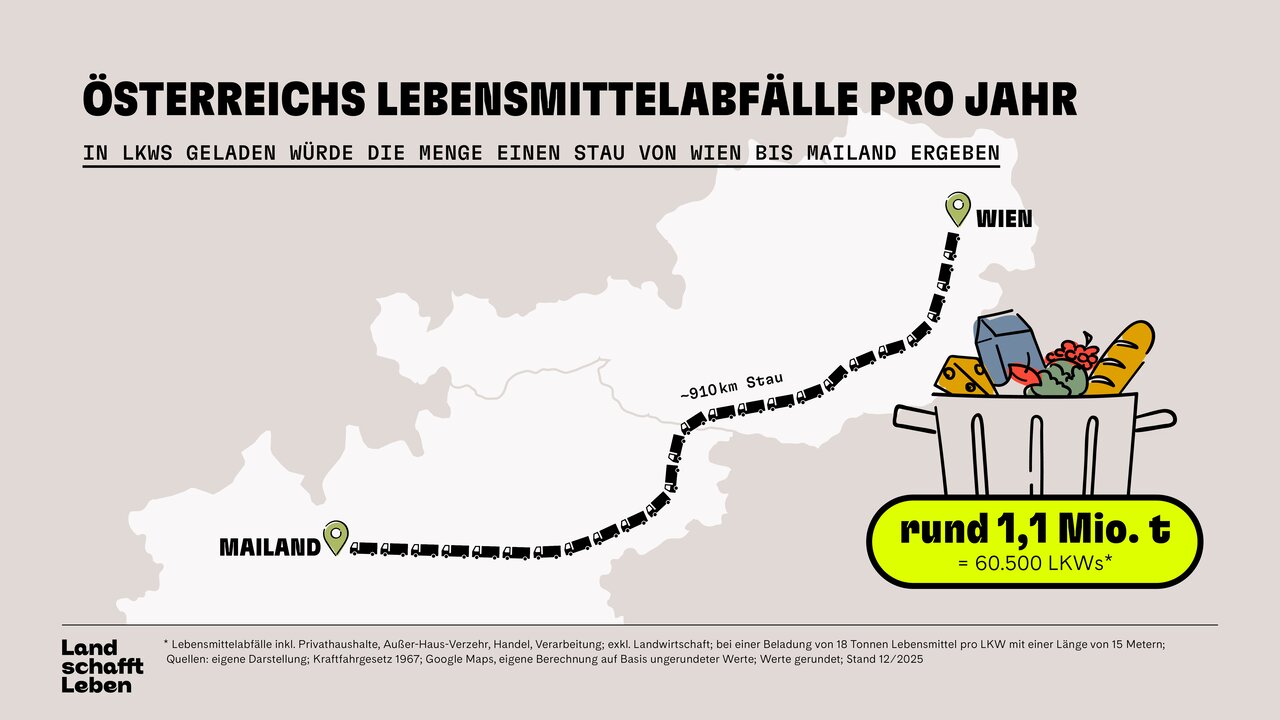
About one-third of the food produced worldwide is lost along the value chain or ends up in the trash. Food loss and waste occur throughout the entire supply chain—from agriculture and processing to retail, the foodservice industry, and private households. Austria also contributes to this problem with over one million metric tons of avoidable food waste per year. This is shown by an estimate of food loss and waste generation in Austria from the year 2024. Agricultural production is not included in this calculation.
Private households as hotspots of waste
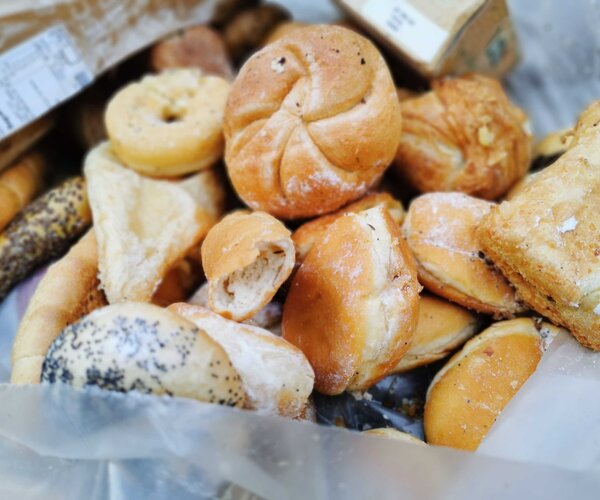
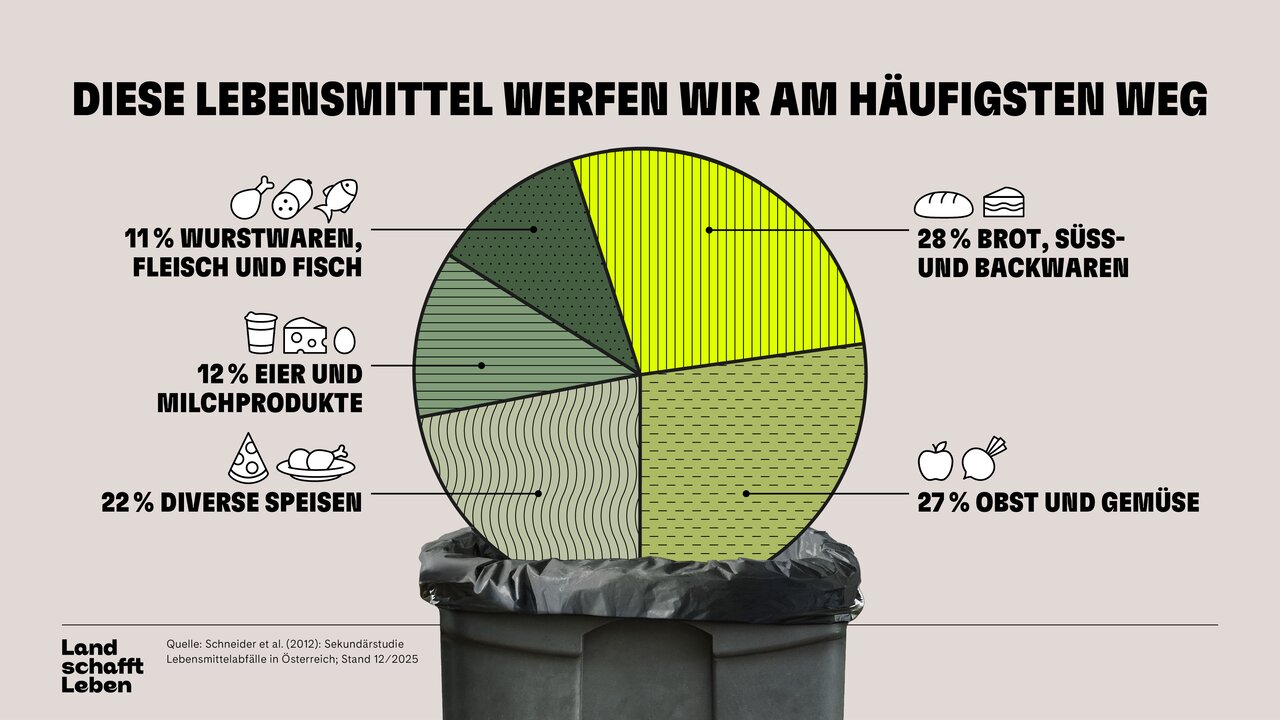
Private households account for the largest share—namely, more than half. Time and again, small amounts such as stale bread, leftovers from lunch, or moldy jam—as well as unopened and properly stored products whose best-by date has passed—end up in the trash. Austrian residual waste analyses show which product groups are thrown away particularly often at home: Bread, sweets, and baked goods top this unenviable list, accounting for just under one-third of the total. Fruits and vegetables are close behind, followed by animal products such as dairy products, eggs, cheese, meat, sausages, and fish. The remaining portion consists of items such as pasta, rice, and beverages.
Each person generates a total of about 75 kilograms of avoidable food waste per year. This also has a financial impact: According to the latest BOKU calculation, the average household throws away food worth up to 800 euros annually. That’s roughly equivalent to two months’ worth of groceries. However, this amount may vary depending on current inflation rates.
Each person generates a total of about 75 kilograms of avoidable food waste per year. This also has a financial impact: According to the latest BOKU calculation, the average household throws away food worth up to 800 euros annually. That’s roughly equivalent to two months’ worth of groceries. However, this amount may vary depending on current inflation rates.
Easy-to-follow tips for reducing food waste
However, every place where food is wasted can become a place where food is saved. Often, it only takes small steps to make a big difference. The first step is to take a critical look at your own behavior and figure out where waste can be prevented. Another area worth examining more closely is the “best before” date. Many foods remain edible longer than the printed date suggests. Examples include canned goods, salt, hard cheese, eggs, cottage cheese, and butter. If you’re unsure, it’s best to rely on your own senses and check the appearance, smell, and taste to determine whether the food is still safe to eat. On the other hand, you should stick to the “use by” date on meat and similar products and avoid eating food after it has expired. However, consumers can start planning even earlier—namely, when shopping. Here’s a tip: Never go shopping when you’re hungry. It’s also a good idea to create a weekly meal plan and shop using a list. This gives you a better overview and helps you avoid being tempted by special offers or discounts to buy products you don’t actually need. Once your groceries have arrived home, they should be stored properly so they stay fresh longer. And if a loaf of bread does get stale or an apple gets shriveled, there are plenty of ways to still make use of the food with a little creativity.
However, every place where food is wasted can become a place where food is saved. Often, it only takes small steps to make a big difference. The first step is to take a critical look at your own behavior and figure out where waste can be prevented. Another area worth examining more closely is the “best before” date. Many foods remain edible longer than the printed date suggests. Examples include canned goods, salt, hard cheese, eggs, cottage cheese, and butter. If you’re unsure, it’s best to rely on your own senses and check the appearance, smell, and taste to determine whether the food is still safe to eat. On the other hand, you should stick to the “use by” date on meat and similar products and avoid eating food after it has expired. However, consumers can start planning even earlier—namely, when shopping. Here’s a tip: Never go shopping when you’re hungry. It’s also a good idea to create a weekly meal plan and shop using a list. This gives you a better overview and helps you avoid being tempted by special offers or discounts to buy products you don’t actually need. Once your groceries have arrived home, they should be stored properly so they stay fresh longer. And if a loaf of bread does get stale or an apple gets shriveled, there are plenty of ways to still make use of the food with a little creativity.
Land creates life: Exploring Austrian Foods
For years, Multikraft has been a sponsor of the organization Land schafft Leben, which raises awareness of the value of Austrian food—for producers, habitats and the environment, health, and for all of us. From the field and barn to the plate, across the entire value chain, researched transparently and independently—Land schafft Leben is the knowledge platform for Austrian food. The founding duo, Maria Fanninger and Hannes Royer, provide realistic insights, free from sensationalism and whitewashing: through podcasts, on social media, in newsletters, at lectures, and in interviews. The scientifically grounded content, presented in text, image, and video formats, is freely available at www.landschafftleben.at.
This may also interest you …

Land creates life: Hot topic - Grilling mindfully just tastes better
No summer is complete without a barbecue! A fun get-together, a wide variety of dishes in a relaxed atmosphere—for many, firing up the grill is simply part of the warm season. What we put on the grill should be anything but a trivial matter: When you consciously choose seasonal vegetables and high-quality meat from Austria, you’re not just enjoying a meal—you’re also supporting local agriculture and regional economic growth.
Beginner
8 minutes reading time

Multi-knowledge: 8 tips for radiant summer skin
August is the perfect time to enjoy nature to the fullest. Whether you’re hiking, at the lake, in the garden, or on vacation—the sun is a part of many wonderful summer moments. At the same time, your skin is exposed to particular stresses during this season. UV rays, heat, wind, and saltwater or chlorinated water can strain the skin’s natural barrier and strip it of moisture.
With the right skincare, you can help your skin stay healthy, supple, and radiant all summer long. Three factors play a key role here: protection, hydration, and regeneration.
Beginner
7 minutes reading time

Multikosmos: PFAS in Cosmetics—Longevity with a Risk
There is a vast variety of skin care and cosmetic products available. No matter what the problem, the market offers a solution to pamper yourself and your skin. For dry skin, you apply moisturizer diligently; for dandruff, there’s the right shampoo; and for wrinkles, there are numerous formulations designed to make your skin glow. But even products intended for good can often—even expensive ones—contain questionable ingredients. We’re talking about PFAS, the so-called “forever chemicals.” They’re frequently used in cosmetics and other products because of their durability, but they’re facing increasing criticism due to their impact on people and the environment. This article explains what they are, how they work, why they can be harmful, and why natural cosmetics offer a genuine alternative.
Beginner
8 minutes reading time
