Careers
Multikosmos: Hope through microorganisms
New Approaches to Managing Persistent Fungicide Residues
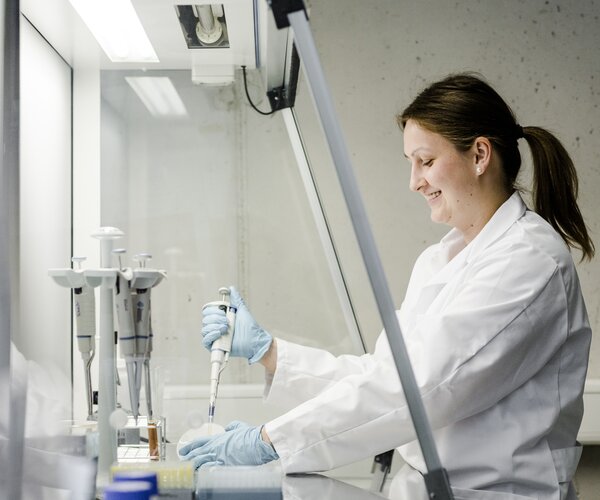
Extreme weather conditions are posing increasing challenges for agriculture—not least due to fungal diseases in waterlogged soils. The agricultural sector has responded to this in particular with the active ingredient azoxystrobin. The problem is that this active ingredient is considered persistent and is suspected of affecting the environment, biodiversity, and human health. Now, study results from our microbiologist Dr. Katharina Kraxberger, MSc, Head of Research and Development at Multikraft, are attracting attention. They show that specific microorganisms can break down fungicides. Her research thus offers hope for bio-based solutions for treating soil and food contaminated with fungicides.
Enthusiast
9 minutes reading time
Pesticides can be detected almost everywhere in the environment. According to reports from the Austrian Agency for Health and Food Safety (AGES), residues of various active ingredients are found in food, water, and soil. They contaminate entire ecosystems and cause resistance in the soil. The result: potential health risks such as cancer, developmental disorders, and neurological diseases—as well as massive loss of biodiversity. This harms both humans and the environment. And yet, there are currently no solutions to break them down more quickly.
Pesticides can be detected almost everywhere in the environment. According to reports from the Austrian Agency for Health and Food Safety (AGES), residues of various active ingredients are found in food, water, and soil. They contaminate entire ecosystems and cause resistance in the soil. The result: potential health risks such as cancer, developmental disorders, and neurological diseases—as well as massive loss of biodiversity. This harms both humans and the environment. And yet, there are currently no solutions to break them down more quickly.
Swift action is needed
The problem is getting worse: Global pesticide use has doubled since 1990, and even residues from earlier decades are still detectable in local soils today. “If we continue as we have been, the majority of our soils could be unusable in about ten years. Coupled with extreme weather events, crop yields in Austria could decline by nearly 50 percent—this primarily affects fertile soils, as current projections show,” says Katharina Kraxberger, citing figures from AGES. Kraxberger therefore addressed this challenge in her doctoral dissertation titled “Fungicide-degrading bacteria: from isolation to product development.” Her research was supported by the University of Natural Resources and Life Sciences, Vienna; project partner the Austrian Institute of Technology (Competence Unit Bioresources); and the funding agency FFG (Austrian Research Promotion Agency).
Challenges in the degradation of persistent pesticides
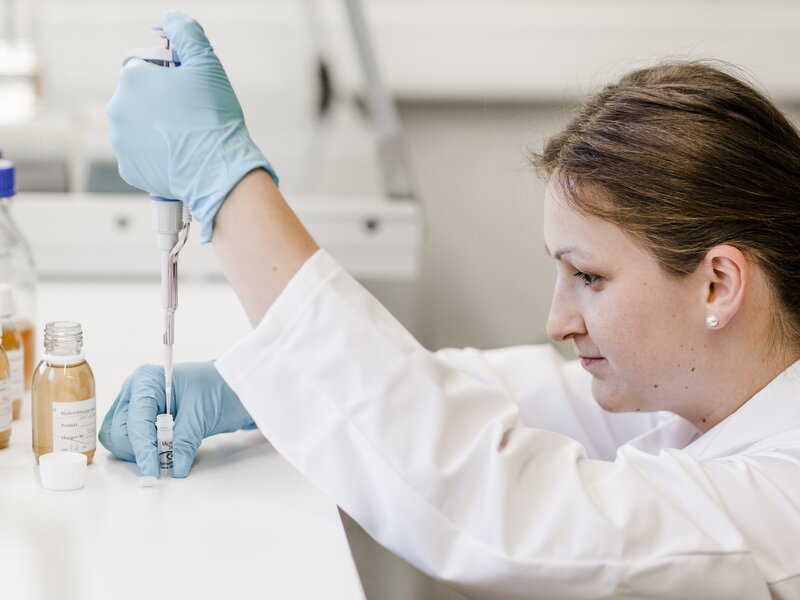
There is significant controversy surrounding this issue: While 450 active pesticide ingredients are currently approved in the EU, there is also a major shift in public attitudes. “Supermarkets and food producers are increasingly rejecting pesticide-contaminated products as pressure from consumers grows. However, farmers need alternatives that actually work to reduce their use of pesticides. So it’s not up to the farmers themselves—even though it’s in their best interest and in the interest of preserving their fields and the health of their animals—but rather up to researchers,” explains Kraxberger.
Although azoxystrobin is one of the most commonly used fungicides in agriculture, little research has been done on its degradation. The fungicide works by interfering with fungi’s ATP production, causing them to die. ATP is the energy source for fungi, produced primarily through cellular respiration. However, it is also suspected of having negative impacts on the environment, biodiversity, and human health. At the same time, with a half-life of up to 300 days, it is considered particularly persistent. Katharina Kraxberger saw this as an urgent reason to search for a solution.
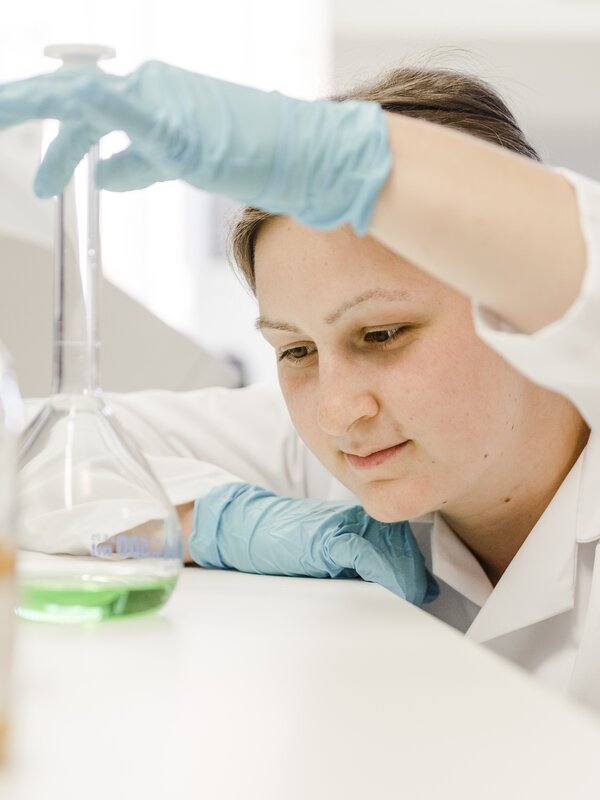
“Azoxystrobin attacks fungi and human cells—and yet this fact is largely overlooked.”
About 25% of global fungicide use falls into the group that includes azoxystrobin—whether on fruits, vegetables, or grains. This creates a particularly urgent need for action. “I have dedicated myself to a problem that most people aren’t even aware of: The active ingredients lying dormant in our environment today—in the soil and in the water—are still the ones that were often applied decades ago. Among them are extremely concerning substances whose mode of action can attack not only fungi but also human cells and other organisms. And yet this is hardly taken into account,” explains Kraxberger. “There are problems that cannot be controlled in intensive production. Neither pesticides nor fertilizers help here; biology is simply what’s needed. Once the biological processes behind this have been researched, even land that has already been abandoned could be restored,” adds Lukas Hader, CEO of Multikraft.
As a result, approaches based on natural degradation processes are becoming increasingly important. That is why Katharina Kraxberger has developed a model that demonstrates how microorganisms could potentially break down this fungicide. Microorganisms were chosen because they naturally perform a variety of functions, such as breaking down organic and inorganic substances or improving nutrient availability in soils and on plants. These benefits extend to agriculture—and thus to all of us.
Identified bacterial strains: Azoxystrobin-degrading and plant-growth-promoting effects
In her work, Katharina Kraxberger identified suitable bacterial strains on leaves, in the rhizosphere, and in Multikraft products that not only break down the fungicide but can also improve plant growth—a double benefit. The most efficient strains demonstrated a degradation rate of 29 to 71 percent. In addition, her work yielded results that, with further research, will form the basis for practical applications. DI Dr. Angela Sessitsch, Head of the Center for Health & Bioresources and advisor for the dissertation at BOKU Vienna, explains:
In her work, Katharina Kraxberger identified suitable bacterial strains on leaves, in the rhizosphere, and in Multikraft products that not only break down the fungicide but can also improve plant growth—a double benefit. The most efficient strains demonstrated a degradation rate of 29 to 71 percent. In addition, her work yielded results that, with further research, will form the basis for practical applications. DI Dr. Angela Sessitsch, Head of the Center for Health & Bioresources and advisor for the dissertation at BOKU Vienna, explains:
“We feel a responsibility to promote sustainable solutions.”
“As a European pioneer in the field of microorganisms, we support numerous research projects and offer a wide variety of solutions for plant strengthening, soil nutrient conservation, livestock manure, and much more—all of which provide farmers with a natural alternative to chemical products,” explains Lukas Hader. “Biological solutions can be researched and produced for almost any problem, provided someone takes on these challenges. We see it as our responsibility to drive sustainable solutions forward in this field,” he continues.
According to Kraxberger, further practical research in product development is now needed to quickly develop a solution that not only works but is also natural and sustainable.
This may also interest you …
livestock farming
Multikosmos: A family business in transition
Strength Lies in Experience
The Weiermair family farm is located in the idyllic town of Adlwang in Upper Austria and is currently home to about 320 pigs. Johannes Weiermair took over his parents’ organic farm in 2011 and has initiated several changes since then. The former mixed-farming operation has been exclusively dedicated to organic pig farming since 2020. As is so often the case in life, such a transition is always accompanied by ups and downs. In this interview, the passionate organic farmer discusses the challenges the family faced and how he continues to tackle them today using common sense.
Enthusiast
8 minutes reading time
livestock farming
Multikosmos: Efficiency over growth
A New Perspective on the Future of Agriculture - A Conversation with Prof. Dr. Wilhelm Windisch
The idea that progress is inevitably synonymous with growth is deeply ingrained in many people’s minds. However, in the face of an agricultural sector grappling with increasingly scarce resources, mounting climate pressures, and ecological limits, a new way of thinking is gaining ground: farming in harmony with nature.
Enthusiast
10 minutes reading time

Between garden plants and balcony boxes: How Huyskweker Stouten relies on the Multikraft system
Arjen Stouten runs Huyskweker Stouten V.O.F. in Oosterland, the Netherlands, together with his family. On approximately 1 hectare of greenhouse space, the family-run business professionally cultivates high-quality summer flowers, as well as a wide assortment of bedding and balcony plants and various perennials. A particular focus is on balcony and patio planters, as well as hanging baskets with built-in water reservoirs. The company sells directly to private end customers throughout the Netherlands and a small part of Belgium.
Enthusiast
5 minutes reading time
