Careers

Land creates life: Energy - How to Make the Most of Your Day
Our performance levels fluctuate, and there are many reasons for this: our physical health, sleep, diet, age, and individual predispositions, among other factors, influence our daily performance curve. The organization Land schafft Leben shows how we can positively influence our performance to really get off to a good start.
Beginner
7 minutes reading time
We can actively influence our performance throughout the day. Getting enough sleep and exercising regularly are essential—as is paying attention to what we eat: A balanced diet that regularly supplies the body with energy is particularly important.
We can actively influence our performance throughout the day. Getting enough sleep and exercising regularly are essential—as is paying attention to what we eat: A balanced diet that regularly supplies the body with energy is particularly important.
Consistent performance instead of energy fluctuations
Let’s imagine a gentle wave curve that represents our energy levels throughout the day: generally, it rises during the morning, dips slightly, and reaches another small peak in the early afternoon. This pattern is highly individual and is primarily determined by our internal clock. Factors such as sleep, exercise, and blood sugar levels can also influence it.
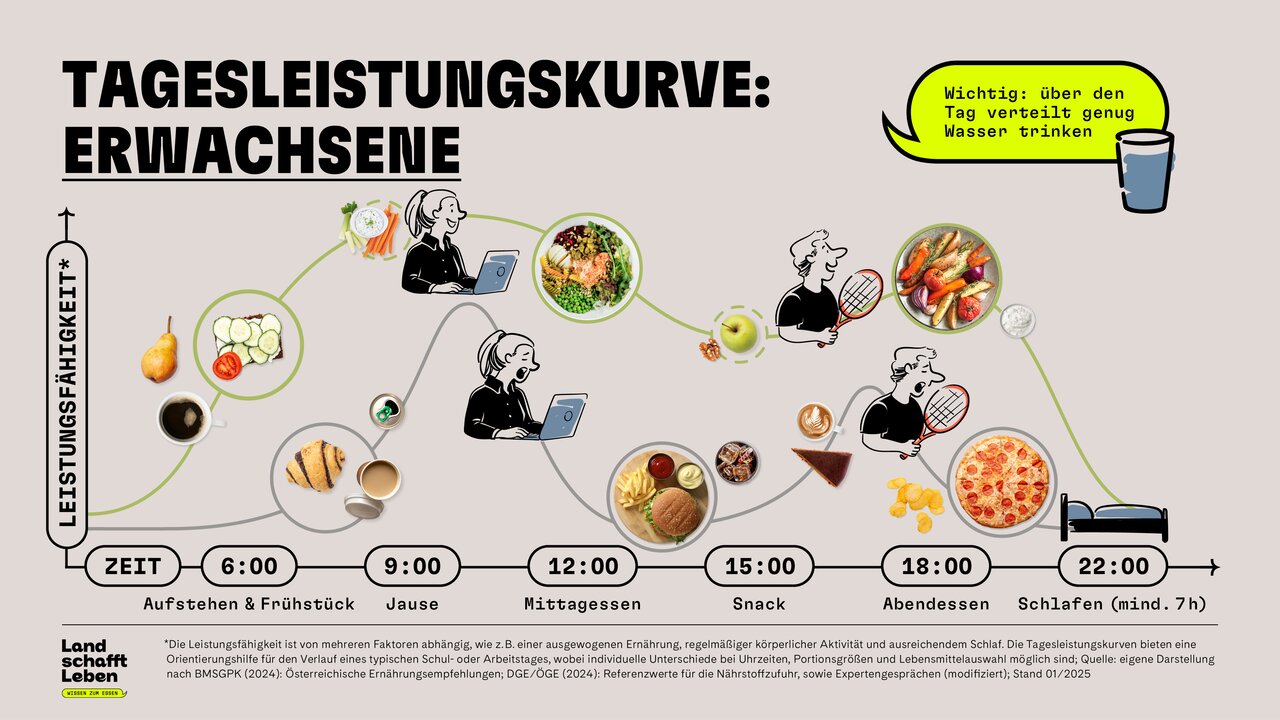
Nutrient-rich foods have a positive effect on blood sugar levels. To provide your body with sustained energy and avoid energy crashes, it’s recommended to opt for complex carbohydrates found in whole grains, legumes, or starchy vegetables like squash, parsnips, or carrots. Since they are digested more slowly, blood sugar levels typically rise more steadily—this ensures that we can concentrate for longer periods and can also prevent cravings. Fluctuations are normal, but more significant ones can lead to an energy slump. A stable blood sugar level is crucial for consistent performance: Frequent snacking, foods high in sugar, fat, or salt but low in nutrients, or irregular meals can cause rapid spikes and drops in blood sugar, making it harder for us to concentrate.
Nutrient-rich foods have a positive effect on blood sugar levels. To provide your body with sustained energy and avoid energy crashes, it’s recommended to opt for complex carbohydrates found in whole grains, legumes, or starchy vegetables like squash, parsnips, or carrots. Since they are digested more slowly, blood sugar levels typically rise more steadily—this ensures that we can concentrate for longer periods and can also prevent cravings. Fluctuations are normal, but more significant ones can lead to an energy slump. A stable blood sugar level is crucial for consistent performance: Frequent snacking, foods high in sugar, fat, or salt but low in nutrients, or irregular meals can cause rapid spikes and drops in blood sugar, making it harder for us to concentrate.

Stay energized all day long: meals perfectly balanced
Here’s how: To prevent an energy slump, you should fuel your body properly first thing in the morning. Since your energy and fluid reserves are depleted overnight, a balanced breakfast rich in protein and complex carbohydrates is especially important for a good start to the day. A good option, for example, is scrambled eggs with pumpkin seeds and whole-grain bread. This helps you stay full longer and start the day with more energy. Additionally, fiber supports steady blood sugar levels and a stable energy supply. It’s important to ensure that every main meal contains all the so-called macronutrients—carbohydrates, proteins, and fats.
The right balance is also key at lunchtime: an ideal plate consists of half vegetables and fruit, a quarter whole-grain products or potatoes, and protein-rich components such as dairy products, eggs, meat, fish, and legumes. In the evening, light, balanced dishes such as vegetable soup with whole-grain bread or roasted vegetables with a yogurt dip are suitable to avoid overburdening digestion. For growing children and adolescents, as well as physically active adults, snacks can be beneficial for maintaining performance. However, there should be breaks of two to three hours between meals.
Tip: Combining complex carbohydrates, proteins, and fats slows down digestion, ensuring that energy is released more slowly and steadily. A particularly good combination is dairy and grain products (such as muesli) or eggs and potatoes.
Tip: Combining complex carbohydrates, proteins, and fats slows down digestion, ensuring that energy is released more slowly and steadily. A particularly good combination is dairy and grain products (such as muesli) or eggs and potatoes.
Rest and Exercise as Performance Factors
Getting enough sleep is essential for well-being, health, and performance. Sleep needs vary by age: for adults, for example, at least seven hours of sleep per night is recommended. In addition to rest, regular physical activity also plays a crucial role. Children and adolescents should engage in at least 60 minutes of physical activity daily, including three sessions per week of higher intensity. For adults, on the other hand, 2.5 to five hours of moderate-intensity physical activity per week is recommended.
As a general rule, energy intake should be tailored to individual activity levels. A balanced intake of high-quality fats, complex carbohydrates, and protein not only supports daily performance but also promotes long-term health. Locally sourced foods are particularly suitable: vegetables and fruits from nearby are usually fresher, have undergone shorter transport and storage times, and can have higher nutrient levels (especially for sensitive nutrients such as vitamin C).
Land creates life: Exploring Austrian Foods
For years, Multikraft has been a sponsor of the Land schafft Leben association, which raises awareness of the value of Austrian food—for producers, habitats and the environment, health, and for all of us. From field and barn to plate, across the entire value chain, researched transparently and independently—Land schafft Leben is the knowledge platform for Austrian food. The founding duo, Maria Fanninger and Hannes Royer, provide realistic insights, free from sensationalism and whitewashing: through podcasts, on social media, in newsletters, at lectures, and in interviews. The scientifically grounded content, presented in text, image, and video formats, is freely available at www.landschafftleben.at.
This may also interest you …

Land creates life: the plate model explained
What does a balanced, regional plate look like? Land creates life shows how carbohydrates, proteins, fats, vegetables, and fruit can be combined on a plate—and why it's not just the ratio of the individual components that counts, but also their seasonality, which is good for our microbiome.
Beginner
5 minutes reading time

Land creates life: high-protein meals with regional foods
Shelves full of protein bars, drinks, and snacks in every flavor imaginable—the protein trend that is ubiquitous on social media has long since arrived in supermarkets. But even athletes can usually meet their daily protein requirements without special products: with regional foods that are less processed, provide high-quality and readily available protein, and at the same time strengthen local agriculture.
Beginner
5 minutes reading time

Fresh breath, healthy teeth: probiotic dental care with Bioemsan
A radiant smile starts not only with white teeth, but with a healthy mouth. Dental care is much more than just an aesthetic ritual – it is an important part of holistic health. More and more people are turning to natural dental care products that not only clean, but also support the oral flora. A special example: bioemsan toothpastes – natural dental care that combines modern oral hygiene with knowledge of the microbiome in the mouth.
Beginner
4 minutes reading time
