Careers
Fermented Herbal Extract (FHE) in Broiler Chicken Production
Less ammonia, more growth: In broiler chickens, Fermented Herb Extract (FKE) reduces ammonia concentrations in the animal housing area by 23% and in the exhaust stack by 30.6%. In terms of growth performance, this resulted in a 39.11% reduction in ammonia emissions, reaching up to 43% in certain phases of the broiler cycle.
The permitting and operation of poultry houses are increasingly subject to emission regulations, and conflicts with neighbors and regulatory requirements are on the rise. Therefore, measures to reduce emissions that can be recognized as “Best Available Technology” (BAT) are being sought. Within this framework, Multikraft’s FKE system was tested in a broiler-fattening operation to assess its impact on harmful gases, odor, and fattening performance.
The study
The LFZ Raumberg-Gumpenstein (project manager: Eduard Zentner, Eng.) conducted the experiment in two structurally identical barn compartments with identical climate control. A total of 500 day-old chicks of the Ross breed were housed in each of the control and experimental compartments, in two pens of 250 chicks each.
Fattening period:
27 days, May 21–June 17; terminated early due to weather conditions (outside temperature of 38.4°C).
FKE application in the experimental section:
House preparation:
- by spraying the floor and ceiling before placement:
- 4 L FKE (15 L FKE per 100 m²) + 12.15 L water (45 L water per 100 m²) of floor area
Feeding:
- FKE added to drinking water on Day 1 and Day 8 (3 mL/chick)
- 1% FKE on pelleted dry feed
Ongoing spraying:
- Weekly re-spraying of the floor area, 1.35 L/week (5 L FKE per 100 m²)
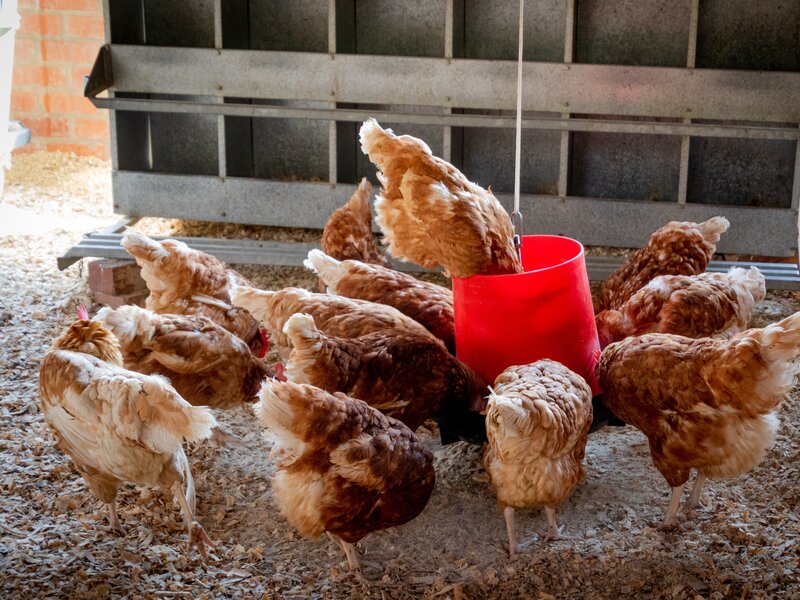
Both pens received identical feed; they differed only in the use of FKE. Straw pellets were used as bedding.
Measurements:
Ammonia (NH₃) and carbon dioxide (CO₂) were continuously recorded in the animal area, the exhaust stack, and the attic using the INNOVA 1412 multi-gas monitoring system (at 15-minute intervals). Odor was assessed olfactometrically (odor threshold measurement, TO8) on four occasions per trial. In addition, weight, feed conversion, and losses were recorded weekly.
The result
Ammonia:
On average, the NH₃ concentration in the experimental pen was 4.25 ppm (animal area) and 3.72 ppm (exhaust stack), respectively, while in the control pen it was 5.53 ppm and 5.36 ppm, respectively (Table 1).
Table 1: Gas emissions—Average values over the entire course of the experiment
Ammonia (NH₃), Carbon Dioxide (CO₂) ppm = parts per million, LU/m³ = livestock unit per square meter
Table 1: Gas emissions—Average values over the entire course of the experiment
Ammonia (NH₃), Carbon Dioxide (CO₂) ppm = parts per million, LU/m³ = livestock unit per square meter
In terms of the animals’ growth performance (grams of ammonia per kilogram of live weight gain), there was a reduction from 2.077 to 1.265 g NH₃/kg gain (39.1%). During fattening phase I, the reduction in individual measurement periods reached up to 42.9% (Table 2). Extrapolated per animal space and year, ammonia emissions fell from 25 g to 15 g, well below the guideline value of 35 g NH₃ per animal space per year specified in the Swiss literature for short-term fattening.
Table 2: Ammonia emissions per kg of weight gain per finishing pen and degree of reduction
Table 2: Ammonia emissions per kg of weight gain per finishing pen and degree of reduction
Odor: The concentration of odorous substances in the exhaust stack decreased by an average of 10.01% (683 vs. 759 GE/m³). Based on actual odor emissions (GE, taking air flow rate into account), the reduction was 6.13% (154 vs. 165 GE/s·GVE), with individual values as low as −37% during the initial phase.
Fattening performance: The final fattening weight averaged 1,480 g in the experimental group and 1,430 g in the control group. Daily live weight gains were 53.3 g in the experimental pen compared to 51.6 g in the control. Feed conversion improved from 1:1.64 (control) to 1:1.58 (experimental), which corresponds to approximately 6 g less feed required per kg of weight gain. The mortality rate was within the typical range for practical conditions and did not differ between the groups (3.2% in the experimental group versus 3.0% in the control group).
Conclusion
In a fattening cycle conducted under high outdoor temperatures, FKE had a significant effect on ammonia and CO₂ emissions, along with a slight improvement in fattening performance and feed conversion.
Despite the greater effort required by users compared to ready-made feed mixtures, the study leaders assessed FKE as a potential alternative or supplement to exhaust air purification.
Do you have questions about the degree programs?
We'd be happy to answer them!
Head of Research and Development, Quality Management
Dr. Katharina Kraxberger MSc
Phone:
+43 7247 50 250 149
