Careers

Improving silage quality
The laboratory experiment
At the Institute for Animal Health (ID-Lelystad) of Wageningen University & Research (Netherlands), a preliminary scientific trial (Report 2165) was conducted to investigate the use of Multikraft systems as silage additives. ¹
For this purpose, grass silage was treated with Multikraft and fermented in 1-kg Weck jars; untreated grass silage was used as a control group in parallel. After 6 days and after 2 months, the most important quality parameters were analyzed in the test group and the control group (Table 1).
At the Institute for Animal Health (ID-Lelystad) of Wageningen University & Research (Netherlands), a preliminary scientific trial (Report 2165) was conducted to investigate the use of Multikraft systems as silage additives. ¹
For this purpose, grass silage was treated with Multikraft and fermented in 1-kg Weck jars; untreated grass silage was used as a control group in parallel. After 6 days and after 2 months, the most important quality parameters were analyzed in the test group and the control group (Table 1).
The result
The silage treated with Multikraft exhibited a lower pH value and lower dry matter loss at both testing times (Table 1). The content of value-determining lactic acid and acetic acid was significantly higher in the silage treated with Multikraft than in the controls. In addition, high levels of 1,2-propanediol and 1-propanol were measured in the silage treated with Multikraft, which may indicate the activity of Lactobacillus buchneri and/or related lactic acid bacteria. This genus of bacteria plays an important role in improving the aerobic stability of silage.
The silage treated with Multikraft exhibited a lower pH value and lower dry matter loss at both testing times (Table 1). The content of value-determining lactic acid and acetic acid was significantly higher in the silage treated with Multikraft than in the controls. In addition, high levels of 1,2-propanediol and 1-propanol were measured in the silage treated with Multikraft, which may indicate the activity of Lactobacillus buchneri and/or related lactic acid bacteria. This genus of bacteria plays an important role in improving the aerobic stability of silage.
Table 1 - Grass Bedding Pilot Study: Laboratory Results for Key Parameters. *The aerobic stability test is typically terminated after 3 weeks because the material dries out too much and no longer yields representative results. g/kg = grams per kilogram, DM = dry matter, n.d. = not determined
¹Source: Institute for Animal Health ID-Lelystad, Wageningen University & Research (NL), Report No. 2165 (P.G. van Wikselaar, S.J.W.H. Oude Elferink).
Table 1 - Grass Bedding Pilot Study: Laboratory Results for Key Parameters. *The aerobic stability test is typically terminated after 3 weeks because the material dries out too much and no longer yields representative results. g/kg = grams per kilogram, DM = dry matter, n.d. = not determined
¹Source: Institute for Animal Health ID-Lelystad, Wageningen University & Research (NL), Report No. 2165 (P.G. van Wikselaar, S.J.W.H. Oude Elferink).
The practical observation
To test the effect of Multikraft on silage under real-world conditions, two field trials were conducted:
To test the effect of Multikraft on silage under real-world conditions, two field trials were conducted:
A) Field trial - Grass and Clover silage
In collaboration with the Schleswig-Holstein Chamber of Agriculture, three different types of forage cuttings (2 grass, 1 clover-grass) were treated with Multikraft and analyzed for parameters determining nutritional value after 3 months of fermentation. An untreated control was included for each experimental group (Table 2).²
The result
Compared to the untreated control, the grass silage treated with MK showed a significant difference in lactic acid content (higher in the MK-treated silage), aerobic stability immediately after removal and 7 days after removal (higher in the MK-treated silage), and a lower pH after post-fermentation (Table 2).
Compared to the untreated control, the grass silage treated with MK showed a significant difference in lactic acid content (higher in the MK-treated silage), aerobic stability immediately after removal and 7 days after removal (higher in the MK-treated silage), and a lower pH after post-fermentation (Table 2).
Table 2 - Field Trial: Grass Silage: Laboratory results for the parameters determining nutritional value for Grass Silage I, II, and Clover Silage, presented as mean values for the experimental and control groups; statistical analysis using a paired t-test. MK = Multikraft, n.s. = not significant
² Source: Schleswig-Holstein Chamber of Agriculture, D-24783 Osterrönfeld: “Silage Additive Testing with EM”; statistical analysis (t-test) performed by Multikraft based on the original data.
Table 2 - Field Trial: Grass Silage: Laboratory results for the parameters determining nutritional value for Grass Silage I, II, and Clover Silage, presented as mean values for the experimental and control groups; statistical analysis using a paired t-test. MK = Multikraft, n.s. = not significant
² Source: Schleswig-Holstein Chamber of Agriculture, D-24783 Osterrönfeld: “Silage Additive Testing with EM”; statistical analysis (t-test) performed by Multikraft based on the original data.
B) Field trial - Corn silage
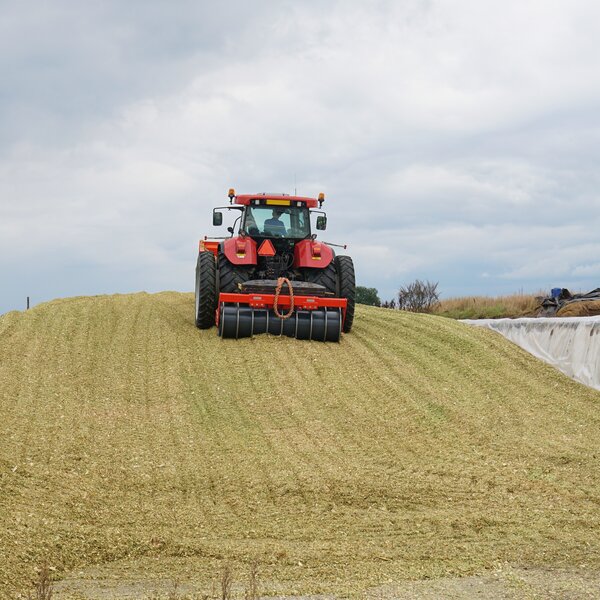
Under the supervision of our field representative Franz Schafferhofer, a mobile silo of corn silage was treated with Multikraft; an untreated mobile silo served as a control.
The analysis of the parameters determining value was conducted by LKS – Landwirtschaftliche Kommunikations- und Servicegesellschaft mbH (test reports nos. 1796169 and 1796170).³
The result
The variant treated with a silage additive contained higher levels of crude protein and acetic acid. Although the lactic acid content in the treated silage was lower than that of the control, the elevated levels of 1,2-propanediol and 1-propanol indicate increased Lactobacillus activity. In addition, a higher propionic acid content was measured (Table 3). Propionic acid acts as a powerful preservative in silage, inhibiting molds, yeasts, and undesirable bacteria. This minimizes nutrient losses and prevents the formation of dangerous mycotoxins.
The following values should be interpreted as descriptive practical findings, not as statistically validated evidence.
The variant treated with a silage additive contained higher levels of crude protein and acetic acid. Although the lactic acid content in the treated silage was lower than that of the control, the elevated levels of 1,2-propanediol and 1-propanol indicate increased Lactobacillus activity. In addition, a higher propionic acid content was measured (Table 3). Propionic acid acts as a powerful preservative in silage, inhibiting molds, yeasts, and undesirable bacteria. This minimizes nutrient losses and prevents the formation of dangerous mycotoxins.
The following values should be interpreted as descriptive practical findings, not as statistically validated evidence.
Table 3 - Field Trial: Corn Silage: Laboratory Results for Key Parameters, MK = Multikraft, g/kg = grams per kilogram, DS = dry matter, Total N = total nitrogen
³ Source: LKS – Landwirtschaftliche Kommunikations- und Servicegesellschaft mbH, Niederwiesa: Test reports No. 1796169-20231213-144705 and 1796170-20231213-144704.
Table 3 - Field Trial: Corn Silage: Laboratory Results for Key Parameters, MK = Multikraft, g/kg = grams per kilogram, DS = dry matter, Total N = total nitrogen
³ Source: LKS – Landwirtschaftliche Kommunikations- und Servicegesellschaft mbH, Niederwiesa: Test reports No. 1796169-20231213-144705 and 1796170-20231213-144704.
Conclusion
The use of Multikraft systems as silage additives ensures a rapid and significant drop in pH, increased formation of organic acids, and high aerobic stability in corn and forage silage. This preserves nutrients and inhibits mycotoxins and putrefactive bacteria.
In corn silage, it has also been shown that more crude protein is retained, resulting in higher nutritional value for the animal.
The use of Multikraft systems as silage additives ensures a rapid and significant drop in pH, increased formation of organic acids, and high aerobic stability in corn and forage silage. This preserves nutrients and inhibits mycotoxins and putrefactive bacteria.
In corn silage, it has also been shown that more crude protein is retained, resulting in higher nutritional value for the animal.
