Careers


EM lunar calendar: Planting in harmony with the moon
Our lunar calendar helps you to prepare Effective Microorganisms in harmony with the phases of the moon—because certain constellations can have a positive effect on the fermentation process.
The EM lunar calendar for the garden
For thousands of years, the moon and its cycles have been used as a guide to find the ideal moments for certain activities. Depending on the moon's orbit around the Earth and the constellation in which this occurs, the Earth's satellite also influences plant growth, among other things. It affects when plants should be planted, sown, or harvested. The EM Moon Calendar therefore offers the best times for carrying out gardening tasks. It is based on centuries-old empirical values from gardeners and farmers that are still valid today. With the EM Moon Calendar, you will also never miss the optimal time to produce Effective Microorganisms Active (base product).
The influence of the moon on plants and gardeners
The Multikraft EM Moon and Planting Calendar is based on the calculations of Maria Thun (1922–2012) and the lunar almanac by Johanna Paungger and Thomas Poppe. Moon gardeners assume that not only large bodies of water are influenced by the moon, but also small ones, such as plant sap. However, when gardening with the moon, it is not only the position of the moon that is decisive: depending on the constellation in which the moon is located, so-called fruit days, root days, flower days, or leaf days are determined, which are favorable for gardening for certain plant groups.
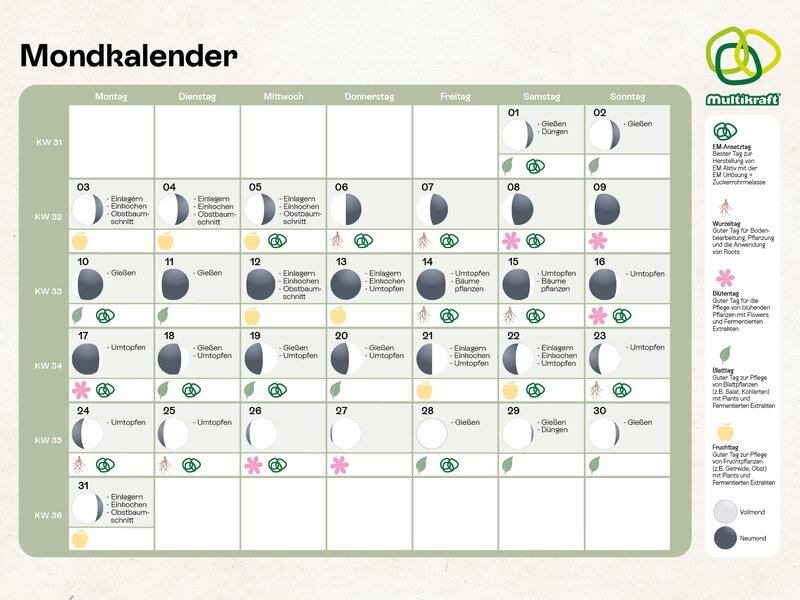
To garden with the moon, simply download our practical and free EM moon and preparation calendar. It shows the appropriate EM preparation, watering, planting, and storage dates based on the moon data.
In our EM moon and preparation calendar, these four plant groups are marked with the following symbols:
The Multikraft EM Moon and Planting Calendar is based on the calculations of Maria Thun (1922–2012) and the lunar almanac by Johanna Paungger and Thomas Poppe. Moon gardeners assume that not only large bodies of water are influenced by the moon, but also small ones, such as plant sap. However, when gardening with the moon, it is not only the position of the moon that is decisive: depending on the constellation in which the moon is located, so-called fruit days, root days, flower days, or leaf days are determined, which are favorable for gardening for certain plant groups.
To garden with the moon, simply download our practical and free EM moon and preparation calendar. It shows the appropriate EM preparation, watering, planting, and storage dates based on the moon data.
In our EM moon and preparation calendar, these four plant groups are marked with the following symbols:
- The yellow apple stands for fruit days:
On fruit days, fruit plants, i.e., varieties whose seeds or fruits are consumed, are sown, tended, or harvested. Pumpkins, peppers, tomatoes, peas, beans, herbs such as dill, fruit, and grains are among the fruit plants. - The brown root stands for root days:
Root plants are ideally sown, tended, or harvested for storage on these days, such as potatoes, carrots, and herbs such as parsley root. - The pink flower stands for flower days:
Leafy plants are ideally sown, tended, or harvested on leaf days. This includes all vegetables whose leaves are harvested, such as lettuce and herbs.
The green leaf for leaf days:
Leafy plants are ideally sown, tended, or harvested on leaf days. This includes all vegetables whose leaves are harvested, such as lettuce and herbs.
- The yellow apple stands for fruit days:
On fruit days, fruit plants, i.e., varieties whose seeds or fruits are consumed, are sown, tended, or harvested. Pumpkins, peppers, tomatoes, peas, beans, herbs such as dill, fruit, and grains are among the fruit plants. - The brown root stands for root days:
Root plants are ideally sown, tended, or harvested for storage on these days, such as potatoes, carrots, and herbs such as parsley root. - The pink flower stands for flower days:
Leafy plants are ideally sown, tended, or harvested on leaf days. This includes all vegetables whose leaves are harvested, such as lettuce and herbs.
The green leaf for leaf days:
Leafy plants are ideally sown, tended, or harvested on leaf days. This includes all vegetables whose leaves are harvested, such as lettuce and herbs.